

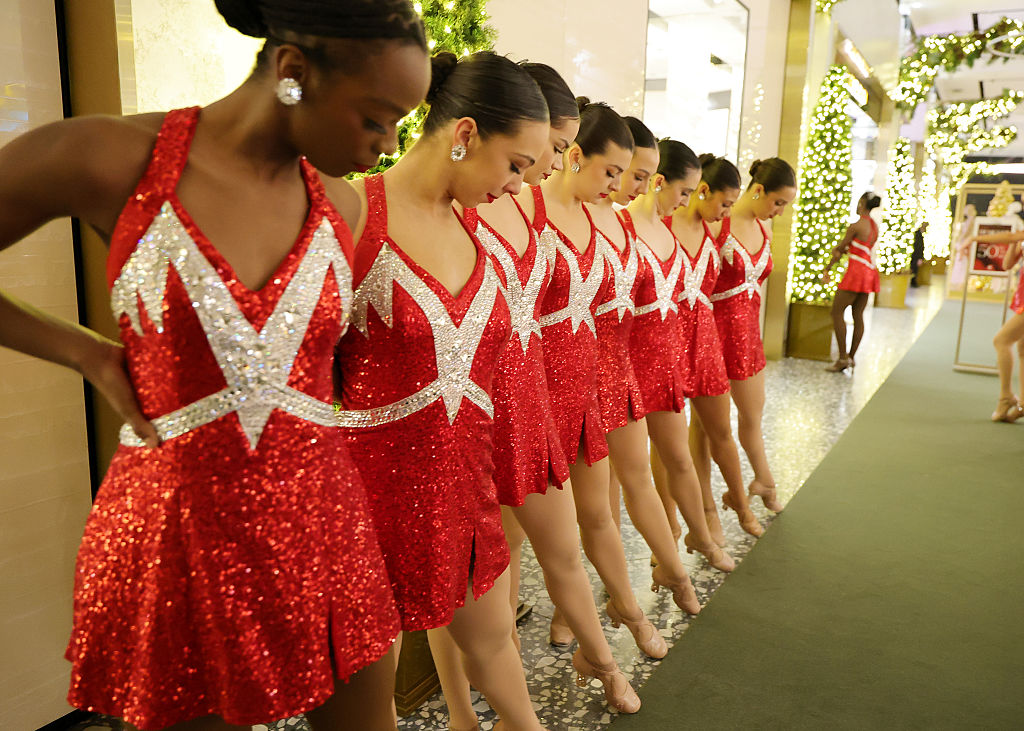
Inside The Glamorous, Gritty Rise Of The Black Rockettes Who Broke Radio City’s Color Line
Source: Mike Coppola / Getty
The Radio City Rockettes, founded in the 1930s, have long been recognized as America’s most iconic precision dance company. But as CBS Miami notes, although the troupe dazzled audiences for decades, “It wasn’t until the 1980s” that they featured performers of color. So, what led to the famous dance troupe diversifying? Here’s what we know about the deep history behind the Black Radio City Rockettes we cherish and love today.
Jennifer Jones was the first Black Rockette.
The breakthrough in diversity for The Rockettes arrived in 1987 when Jennifer Jones became the first Black Rockette in the company’s history. As she recalled in a piece for Dance Magazine:
“On January 31, 1988, I made my national debut with the world-famous Radio City Rockettes at the NFL Super Bowl halftime show in San Diego.” It was a moment that both marked her arrival and signaled a turning point in the troupe’s overwhelmingly white legacy.
RELATED CONTENT: The New Tamia Shuffle? How ‘Boots On The Ground’ Became A Line Dance Sensation
Jones, who grew up dreaming of dancing after seeing Broadway classics like Pippin, Hair, and The Wiz, has spent decades pushing for greater diversity in the arts. She recently shared her journey through her children’s book, On the Line: My Story of Becoming the First African-American Rockette. Reflecting on her historic accomplishment, she told ABC News in 2024:
“…When I auditioned for the Rockettes, [and] when I was offered the job, I not only got to do what I love to do, but I ushered in a whole new era, and a whole line of Black ladies can now stand on the Radio City Music Hall stage and say, “‘I’m a Rockette.’”
Jennifer Jones’s history-making came with resistance.
Her trailblazing role wasn’t easy. “With change comes resistance,” she remembered. Some dancers embraced her, “women who wanted to show me the Rockette technique,” and she received “fan mail all across America.” But there were those who rejected the shift.
“I did feel that, but I leaned into the love and the love of my dancing, and that’s what got me through.”
Jones said that resistance sometimes came from leadership itself. She wrote in Dance Magazine:
“Rockettes founder Russell Markert had once been quoted as saying, ‘If a girl got suntanned and she was alongside a girl who could not get the sun, it would make her look like a colored girl.’ And then later, Rockettes choreographer Violet Holmes infamously and publicly stated, ‘One or two Black girls would definitely distract. You would lose the whole look of precision, which is the hallmark of the Rockettes.’”
Reflecting on the negative comments, Jennifer Jones penned that she was “deeply concerned by the notion that the Rockettes were not evaluated based on talent but rather on racial identity, which points to a troubling systemic and institutionalized racism within the performing arts.” She reflected on how the troupe’s earliest roots as the Missouri Rockets in 1925 reinforced inequality, when Black performers were barred from dancing alongside white ones.
The Rockettes remained largely white for years after their inception.
Source: Manoli Figetakis / Getty
It took decades of advocacy before Jones could walk, and so many Black Rockettes could soar. According to the Rockettes’ own history, the troupe was initially called the “Missouri Rockets” before they moved from St. Louis to New York City, becoming the Roxyettes and later the Rockettes in 1932. Their famous Christmas Spectacular debuted the next year. Yet for much of the 20th century, the line remained almost entirely white due to segregation.
Change gained momentum in 1984 when Gregory J. Peterson called out the lack of diversity in his thesis, The Rockettes: Out of Step with the Times, writing: “More than five thousand women have danced with the group since it was created in the 1920s, every one of them white,” according to Vocal Media. His work pushed companies to interpret the 1964 Civil Rights Act more clearly and adopt better hiring practices for dancers of color, which helped Jones make history.
Danielle Jolie Dale-Hancock was the second Black Radio City Rockette.
Among the next breakthroughs was Danielle Jolie Dale-Hancock, the second Black Rockette and the first woman of color to rise to Dance Captain, a role she held for 18 years until retiring in 2011. She told Vocal Media that the troupe still practiced subtle segregation during the early stages of her career:
“Just so you should know, when Sally said there were 13 women of color, they were not all in the same line…So you would see maybe one person of color on one line, maybe two on another.”
Today, Danielle Jolie Dale-Hancock is part of the Radio City Rockettes of Color Alumnae, founded in 2017 and now made up of 63 dancers of color who support, mentor, and educate current and aspiring Rockettes of color. ROCA is an independent organization, not formally affiliated with Radio City Music Hall, the home of The Rockettes.
Progress has been huge since. Notably, diversity is a key theme on The Rockettes’ popular blog site, reading like a vibrant mosaic: part pop-culture lens, part dance diary, and part global celebration. Its features highlight a refreshed identity for the troupe, spotlighting personal profiles of the African American Rockettes currently in the troupe, Black history, and stories that connect with and inspire Black youth.
Still, Dale-Hancock shared with Vocal Media that the real progress she hopes to see lies not only within the troupe itself, but behind the scenes, particularly among leadership at Radio City Music Hall. She believes diversifying leadership can lead to more inclusion.
“It starts at the top, and it is not going to get any better until they diversify there.”
Danelle Morgan is another Black dancer bringing change to the troupe.
Thanks to pioneers like Jones and Dale-Hancock, Black dancers are not only represented but thriving within the Rockettes. One standout example is Danelle Morgan, a celebrated performer in the Christmas Spectacular. Reflecting on how her training at the Ailey/Fordham BFA Program led her to land a role with the troupe, she shared on the Rockettes’ page in part:
“The incredibly well-rounded program provided me with a strong base of technique that gave me a genuine sense of excitement in preparing to take on the dance world,” she said. “One amazing opportunity that I had while studying at the Ailey School was the chance to participate in workshops with the Rockettes, which sparked my interest in becoming a Radio City Rockette. Thanks to these workshops, I auditioned for the Christmas Spectacular and was hired during my junior year of college! I fell in love with the work and, 16 years later, still love what I do!”
So many doors have opened since. Morgan was honored with her very own Madame Tussauds wax figure in 2024 due to her spectacular dancing with the troupe.
From exclusion to historic firsts to a flourishing new generation, the story of the Black Radio City Rockettes is one of resilience, talent, and the determination to transform a legacy, kick by kick.
RELATED CONTENT: ‘So You Think You Can Dance’ Star Donyelle Jones Dies At 46 — Inside Her Brave Final Weeks
The post Inside The Glamorous, Gritty Rise Of The Black Rockettes Who Broke Radio City’s Color Line appeared first on MadameNoire.
Source link
#Glamorous #Gritty #Rise #Black #Rockettes #Broke #Radio #Citys #Color #Line
powered by Auto Youtube Summarize
Tags Black Broadway Broke Citys Color Dancers Glamorous Gritty Line Radio Rise Rockettes Trending